
International Security @ 50

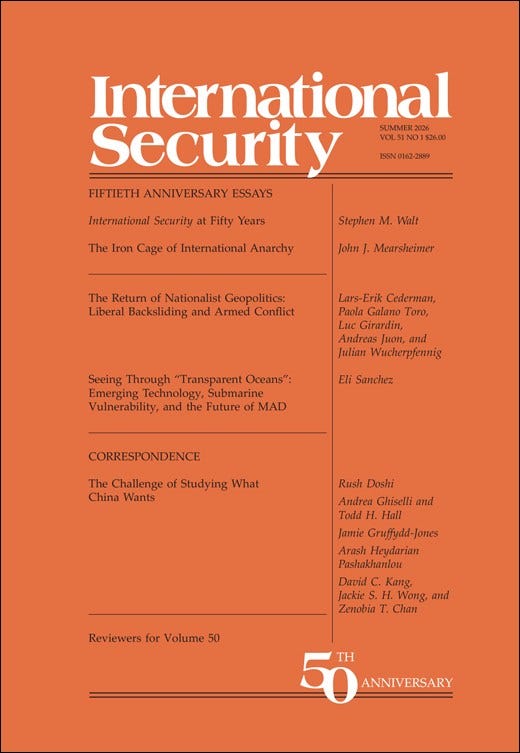
In the summer of 1976, after I had just completed my first year of graduate school at Cornell University, I received the first issue of a brand new journal called International Security. Volume 1, Number 1. Of course, it quickly became the leading scholarly journal dealing with security affairs as well as one of the elite journals in the broader field of international relations. I never imagined at the time that there would be a 50th anniversary issue, much less that I would write an article for that distant issue. But here we are, 50 years later.
My piece examines the security competition among the great powers that has been endemic to the modern system of industrialized nation-states that began emerging in Europe around 1800. I attempt to describe and explain the principal features of that competition over the past 226 years, paying special attention to how it has evolved during the fifty-year history of International Security (1976–2026). The article also considers the likely contours of great power competition in the next fifty years, focusing on determining which countries are likely to be great powers, what is the likely distribution of power among them, and what are the prospects for a future great power war.
Here is a link for my piece and below that, a link for Steve Walt’s highly informative essay on the journal’s history.
https://direct.mit.edu/isec/article/51/1/32/138117/The-Iron-Cage-of-International-Anarchy
https://direct.mit.edu/isec/article/51/1/11/138112/International-Security-at-Fifty-Years
Dear Dr. Mearsheimer,
I hope this note finds you well.
Having long engaged with your work on offensive realism and structural geopolitics, I have spent recent years expanding upon these foundational concepts to address broader systemic and existential challenges facing our species—specifically at the intersection of geopolitical stability, civilizational sustainability, and the accelerating development of artificial intelligence.
While systemic change often builds from the bottom up, the rapid pace of technological acceleration demands focused leadership and structural solutions from the top down. To that end, I have developed a concrete framework addressing both the root causes of these convergence risks and practical paths forward, which forms the core foundation of my upcoming 2028 presidential bid.
My primary goal, however, is grounded in service and rigorous discourse. I would welcome the opportunity to present a selection of short films and deliver a brief talk to your graduate students or department at the University of Chicago. The objective is to share these ideas, engage in constructive debate, and offer a distinct perspective on long-term civilizational alignment and global governance.
Please consider whether a student-led seminar, informal presentation, or departmental guest lecture might be an appropriate venue for this discussion. I would be honored to visit Chicago and share this work with your academic community.
Thank you for your time and continued contributions to the field.
Sincerely,
Kevin C. Flynn
kevincflynn1@gmail.com
In you article you wrote: "Russia-Ukraine War makes no strategic sense for the United States; "
Wrong. USA is far more threatened by Europe+Russia than China+Russia. Europe+Russia combination has the potential to push USA out of Europe, Africa, Arabian peninsula and maybe even Latin America and Canada eventually. Whereas Asia is lost to USA regardless of whether China has Russia backing or not, such is Chinese economic power. Ukraine war makes perfect strategic sense for USA as a way to keep Europe and Russia apart. Once Russia pacifies Ukraine, USA will surely try to start another war between Europe and Russia. UK, serving as USA attack dog in exchange for the permission to profit from money laundering, will help USA create this war.